

By JC Bowman
Title graphic credit: Matt O’Hern
The recent changes to Tennessee’s Education Savings Account (ESA) program mark a strategic shift rather than a sweeping expansion, focusing on redefining accountability rather than broadening access. Some policymakers wanted to use the legislation to expand ESA vouchers further, but the Tennessee Senate said no this year.
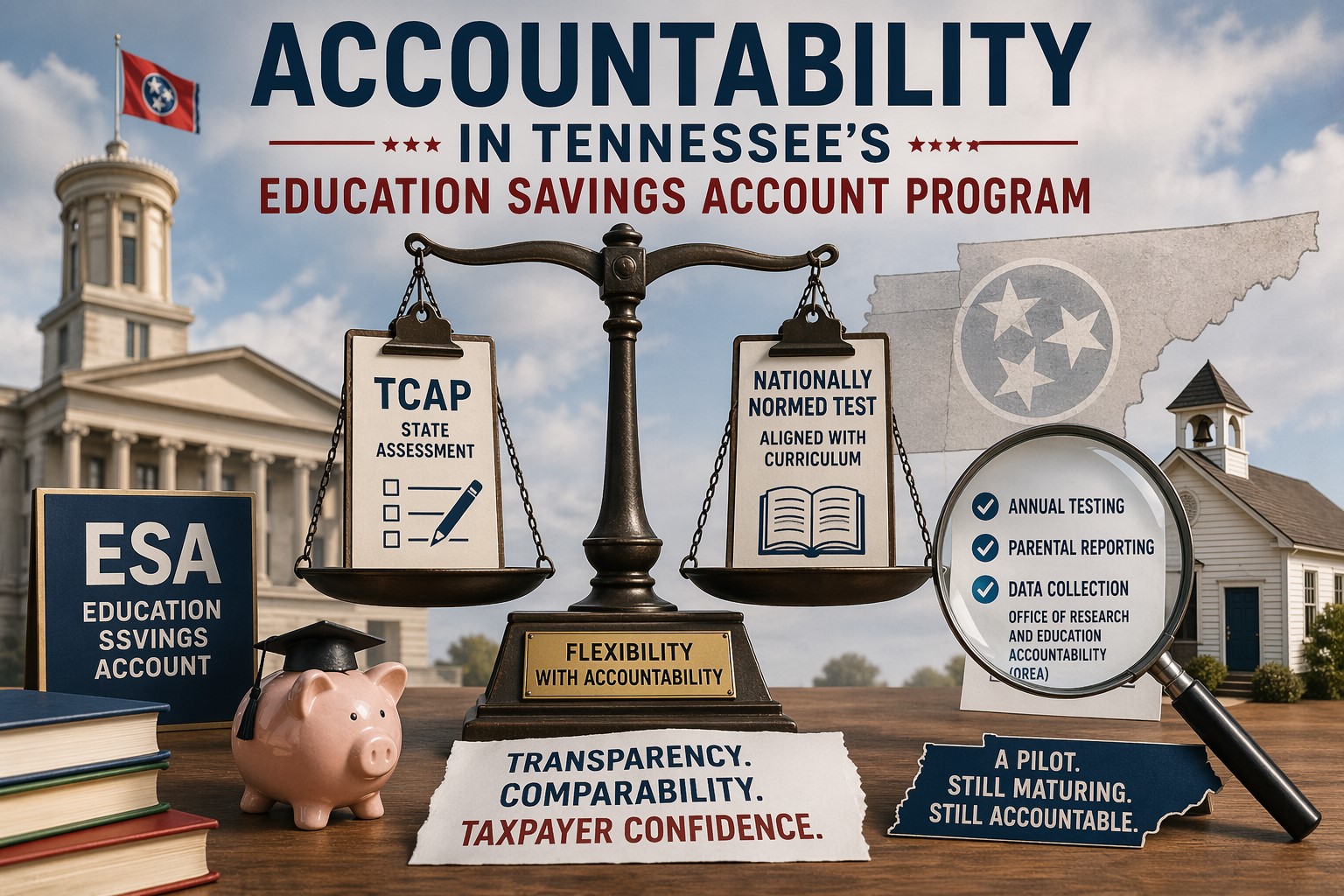
With the passage of House Bill 1881, lawmakers have moved away from a single testing standard, embracing flexibility in assessment options for private schools participating in the program. Participating private schools can now opt for either the state’s TCAP exam or a nationally normed test aligned with their curriculum.
Proponents of this change argue that it is a pragmatic solution. Concerns were raised about ESA students undergoing dual testing, but no conclusive data has substantiated those concerns. Advocates for HB 1881 contend that the TCAP does not necessarily reflect the instruction students receive, making a streamlined approach a reasonable aim.
However, this shift carries significant implications. When Tennessee launched its ESA pilot, it promised that public funding would include clear accountability—enabling straightforward comparisons. That clarity was essential for policymakers and taxpayers to assess the program’s effectiveness. House Bill 1881 undermines that clarity.
Although it retains annual testing, parental reporting, and data collection through the Office of Research and Education Accountability (OREA), the departure from a common assessment standard complicates “apples-to-apples” comparisons. Even supporters of the bill acknowledge this challenge. Perhaps Tennessee should revisit its standards and assessment strategy when the next Governor takes office in January 2027.
This is particularly important given the recent evaluation by the Comptroller, which showed that ESA students are improving yet still lagging behind their public school counterparts. Faced with these findings, lawmakers opted to adjust the framework rather than reinforce comparability.

It’s important to note that flexibility isn’t necessarily a step back. Schools use varied educational approaches, and a uniform test may not adequately reflect those distinctions. There’s a compelling argument that aligning assessment with instruction can yield more meaningful insights into student learning. Still, the program was identified and passed as a pilot project, and the state just said its pilot project did not meet its objectives.
Nonetheless, the critical issue remains: while students continue to be tested, will the state—and the public—be able to interpret the results clearly enough to guide future policy? And who will be able to interpret and compare the results in plain English for taxpayers?
In this regard, HB 1881 doesn’t resolve the accountability debate; it simply reconfigures it. Tennessee continues to exercise oversight, albeit with a gentler approach, focusing on aggregated reporting and selective TCAP sampling rather than universal comparisons.
The ESA pilot continues without expansion, reflecting an understanding that the program is still maturing. However, this evolution shouldn’t compromise clarity.
If the aim is to foster long-term confidence in school vouchers, transparency cannot be merely procedural; it must be straightforward and comprehensible. We need transparency and accountability for all tax dollars. Tennessee has opted for flexibility this year, but it must ensure that this flexibility does not devolve into ambiguity.
The ESA pilot was designed to gather evidence, but changing evaluation metrics mid-pilot undermines the experiment. Existing concerns about standards and TCAP’s effectiveness were already debated before the 2019 law.
This moment is crucial; accountability must not be a moving target. For parents to make informed choices and for taxpayers to support them, success measures must be clear, consistent, and comparable. Otherwise, we risk obscuring opportunities rather than expanding them.
Tennessee must clarify what meaningful accountability looks like across various educational settings. If the criteria shift based on the system, it undermines accountability altogether.
#####
JC Bowman is the Executive Director of Professional Educators of Tennessee, a non-partisan teacher association headquartered in Nashville, Tennessee. Permission to reprint in whole or in part is hereby granted, provided that the author and the association are properly cited. For more information on this subject or any education issue please contact Professional Educators of Tennessee. To schedule an interview please contact info@proedtn.org or 1-800-471-4867.

Legal Notice: This message and any attachments may contain confidential and legally privileged information. This e-mail and any attachments are confidential and are intended solely for the named addressee(s). Please refrain from including sensitive data, such as social security numbers and passwords, in non-encrypted emails and non-password-protected email attachments when responding. Any review, retransmission, dissemination, or other use of, or taking of any action in reliance upon this information by persons or entities other than the intended recipient is prohibited. Suppose the reader of this message is not the intended recipient (or an agent responsible for delivering it to the intended recipients). In that case, you are notified that you have confidential and privileged information and are officially notified that any unauthorized distribution or copying of this communication or the information contained in it is strictly prohibited. If you are not a named addressee, you should not copy, alter, post, forward, distribute, or disseminate the contents of the e-mail, either whole or partial, or attachments without the sender’s written permission. Please notify the sender immediately by e-mail if you have received this e-mail by mistake, and delete this e-mail from your system. Any views or opinions expressed may solely be those of the individual and may not necessarily represent those of Professional Educators of Tennessee (ProEdTN or PET). Please note That Emails sent from a government computer or a government-issued email account are not considered private.







You must be logged in to post a comment.