

By JC Bowman
Parents deserve a clear answer to a simple question: Is my child learning what they need to know? Too often, they receive scores, labels, and rankings that require an interpreter.
Schools have a responsibility to report learning honestly, explain it clearly, and work with families when children need help.
Confusion has consequences. Families can miss learning gaps. Children can mistake difficulty for inability. Teachers can spend conference time explaining conflicting signals instead of developing a plan. Clear information should help families act with confidence and maintain high expectations.
The problem begins with measurement. Comparing schools across state lines often means comparing different standards, assessments, and definitions of success. Even familiar terms such as “proficient,” “meets expectations,” and “grade level” are not interchangeable.
The National Assessment of Educational Progress, known as the Nation’s Report Card, provides a common yardstick across states. But its “Proficient” category describes solid performance on challenging material. It does not mean meeting state grade-level expectations. Confusing those definitions can mislead families.
School comparisons also need context. Achievement measures show performance against a benchmark. They cannot, alone, tell us how much a school helped students learn. Prior achievement, poverty, student mobility, disabilities, and language needs shape students’ starting points.
Growth measures examine progress over time. They offer useful estimates, but have limitations. A school can produce substantial growth while students remain below expectations. Another can report high achievement while students make little progress. Families need both measures.
The same care applies to parental perceptions. Learning Heroes research has found that nearly nine in ten parents believe their children are at or above grade level. That deserves attention. But comparing those beliefs directly with NAEP proficiency rates cannot establish the precise size of a perception gap. The measures ask different questions.

Report cards can also leave an incomplete picture. Grades may combine academic mastery with homework completion, participation, improvement, or effort. Those qualities matter. Parents also need to know whether their child can independently read assigned material, explain an argument, or solve the expected mathematics.
A reassuring grade should begin a conversation about learning, not carry it alone.
Tennessee families have useful resources. The TCAP Family Portal provides individual assessment information. The State Report Card offers school and district results. TVAAS provides growth information. Families still need help connecting those results to their child’s needs.
A school’s letter grade cannot describe every classroom. A statewide ranking cannot explain why a child struggles with fractions. Someone must connect the numbers to the child.
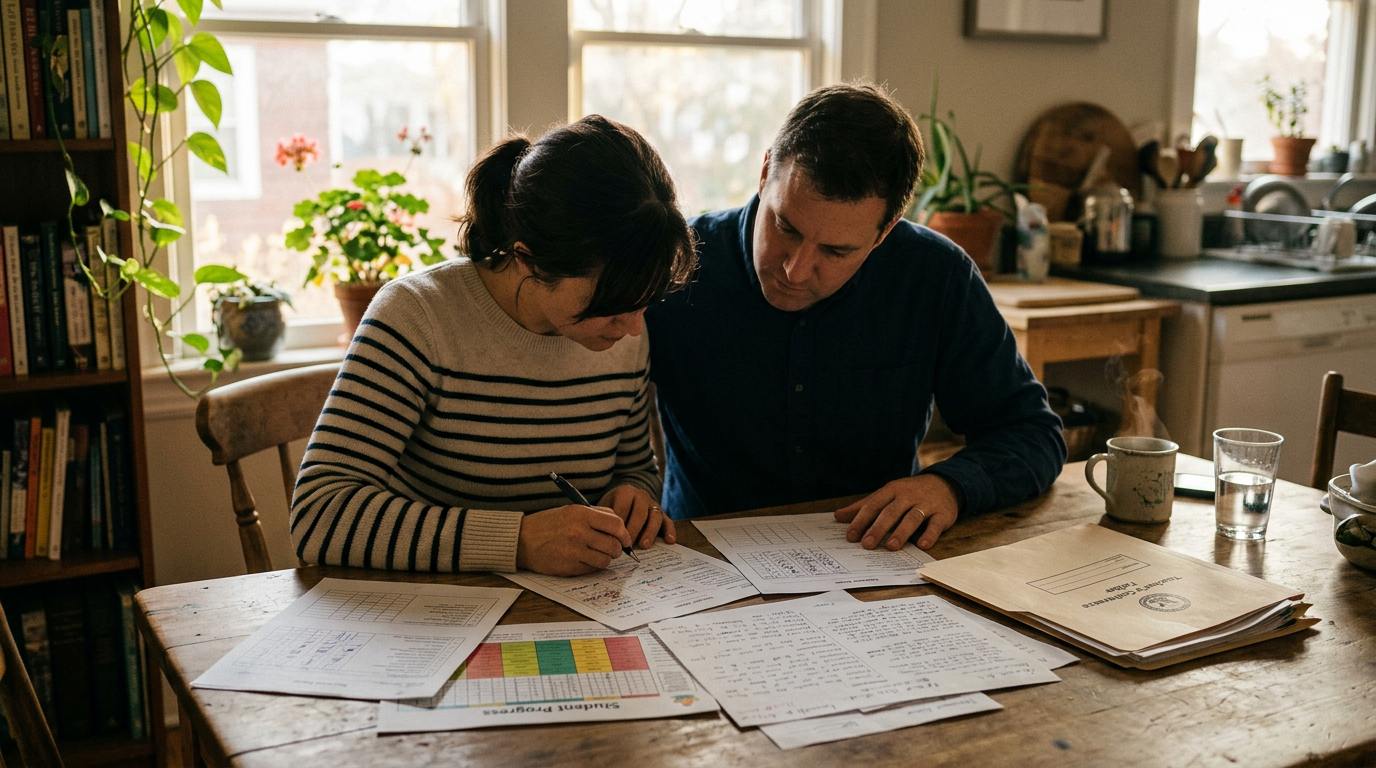
Three questions can make a conference more productive: What can my child do independently? Where is help needed? What should we do together over the next month?
Review schoolwork regularly. Compare classroom performance with assessment results. When the signals disagree, ask why. Agree on a manageable plan and a date to review progress.
Keep conversations encouraging. A child should hear, “We have found something to work on, and we will help you.” Ask what feels difficult. Read together. Protect time for sleep and study, and make attendance a priority. Praise persistence and recognize improvement. Pair high expectations with steady support.
Parents are their children’s first teachers and lifelong advocates. Information should strengthen that relationship and give families a shared purpose.
For families comparing schools, ask what each result measures, which students it includes, and whether the comparison is fair. Visit schools, talk with educators, and discuss your child’s needs before treating a ranking as a verdict.
Transparency requires clear definitions, achievement and growth presented together, and practical next steps. Its value rests in what families and schools can do with the information.
Parents deserve honest answers. Teachers deserve the time and support to provide them. Children deserve adults who turn that information into action.
#####
JC Bowman is the Executive Director of Professional Educators of Tennessee

Legal Notice: Permission to reprint this editorial in whole or in part is hereby granted, provided that the author (or authors) and Professional Educators of Tennessee are properly cited.





You must be logged in to post a comment.